Public delivery
Public delivery is the surface your frontend hits. It serves published content only, authenticates with a project-scoped API key (no JWT, no user session), and is safe to call from browsers and mobile apps.
GET https://api.sandbox.ovok.com/v1/public/cms/{typeSlug}/items?environment=dev&projectId={medplumProjectId}
GET https://api.sandbox.ovok.com/v1/public/cms/{typeSlug}/items/{idOrSlug}?environment=dev&projectId={medplumProjectId}
Required query parameters
| Param | Required | Description |
|---|---|---|
environment | Yes | dev, staging, or prod — selects the content partition |
projectId | Yes | Medplum project UUID; resolves the Payload tenant |
Use projectId, not projectSlug, on this surface.
Authentication
Send the API key as Authorization: Bearer …, x-api-key: …, or
?apiKey=…. Each key is bound to exactly one project when
PAYLOAD_CMS_PUBLIC_API_KEY is configured on ovok-core (sandbox may
allow unauthenticated access when that env var is unset).
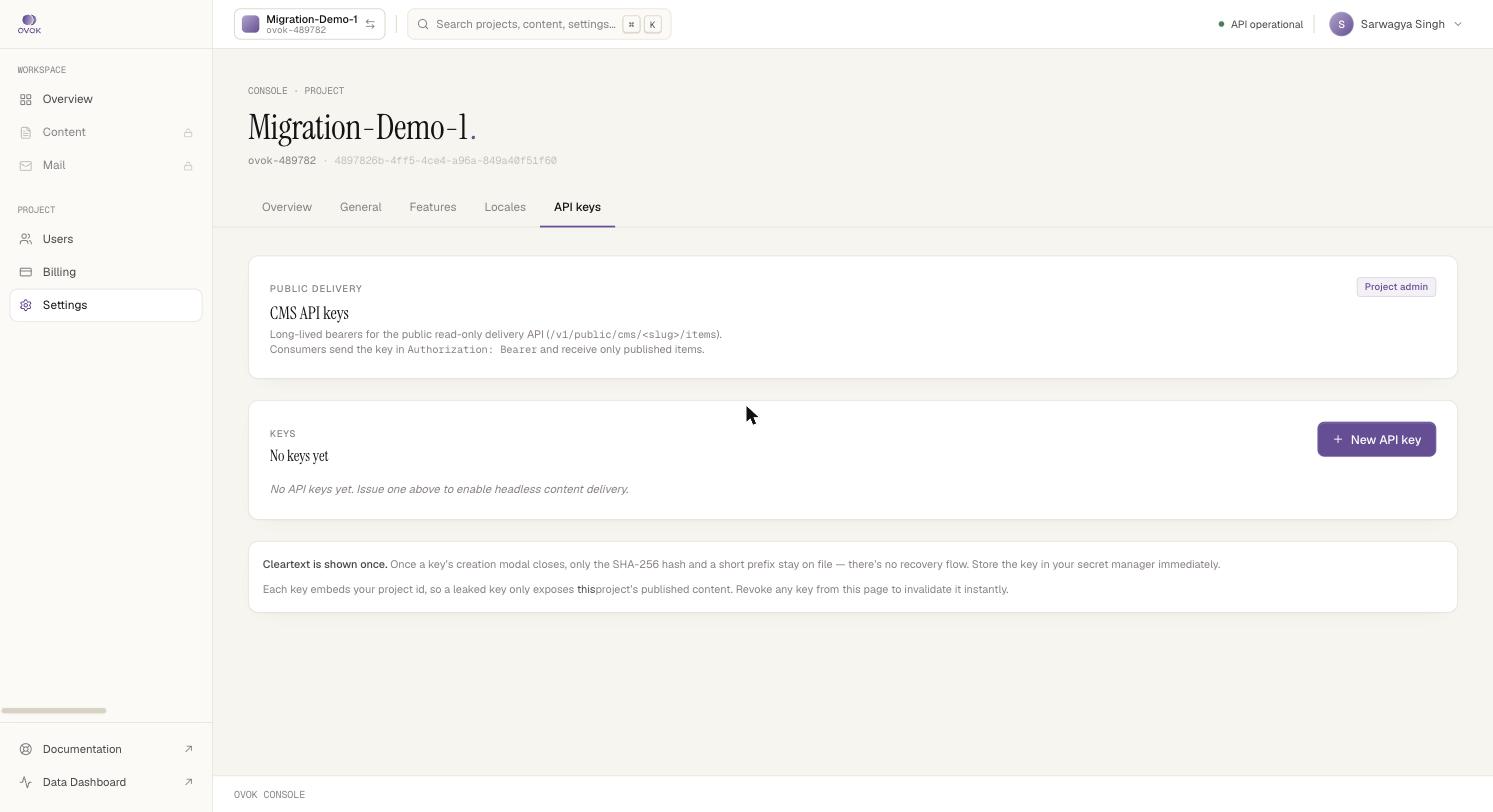
Mint keys from the Console at Settings → API keys → CMS:
GET /v1/public/cms/pages/items?environment=dev&projectId=4897826b-4ff5-4ce4-a96a-849a40f51f60 HTTP/1.1
Host: api.sandbox.ovok.com
Authorization: Bearer cmspub_a4f3b21c...
Accept: application/json
:::tip Key safety API keys identify your project. They're meant to be shipped in your frontend bundle — they only grant read access to published content. But: rotate them on schedule, scope them per app, and never check them into a public repo. :::
List items in a collection
curl "https://api.sandbox.ovok.com/v1/public/cms/pages/items?environment=dev&projectId=$MEDPLUM_PROJECT_ID" \
  -H "Authorization: Bearer $OVOK_CMS_KEY"
Additional query params:
| Param | Type | Description |
|---|---|---|
limit | integer | Max items per page (default 10, max 100) |
page | integer | 1-indexed page number |
sort | string | Sort field, prefix - to reverse (-publishedAt) |
where[field][op] | JSON | Payload's standard filter syntax |
Example — recent published blog posts, newest first:
curl "https://api.sandbox.ovok.com/v1/public/cms/posts/items?environment=dev&projectId=$MEDPLUM_PROJECT_ID&sort=-publishedAt&limit=5" \
  -H "Authorization: Bearer $OVOK_CMS_KEY"
Get one item
By ID:
curl "https://api.sandbox.ovok.com/v1/public/cms/pages/items/abc123?environment=dev&projectId=$MEDPLUM_PROJECT_ID" \
  -H "Authorization: Bearer $OVOK_CMS_KEY"
By slug (Payload's slug field, if your collection defines one):
curl "https://api.sandbox.ovok.com/v1/public/cms/pages/items/pricing?environment=dev&projectId=$MEDPLUM_PROJECT_ID" \
  -H "Authorization: Bearer $OVOK_CMS_KEY"
The endpoint resolves slug vs ID automatically. Drafts and unpublished
items return 404 here regardless of whether you ask by ID or slug.
What's not returned
Public delivery hides the bits authors don't want public:
- Items with
_status: draftor_status: publishedbutpublishedAtin the future - Soft-deleted items
- Internal-only fields (anything marked
admin.hiddenin the Payload collection config) - Items not in the key's project or wrong
environment
If you can read an item via /v1/content/api/... but not via
/v1/public/cms/.../items/..., check draft status, environment, and
projectId first.
CORS
Public delivery is the only CMS surface with browser-friendly CORS.
The proxy returns Access-Control-Allow-Origin: * for GET and
HEAD. If you need a stricter origin set, terminate at your own
edge (Vercel, Cloudflare) and lock CORS there.
Caching
Responses include Cache-Control: public, max-age=60, s-maxage=300
by default — a minute on the client, five minutes on shared caches.
Publishing an item invalidates the shared cache for that item's
collection via a fan-out hook. Custom cache headers per collection are
on the roadmap.
Errors
| Status | Meaning |
|---|---|
401 | API key missing or revoked |
403 | API key belongs to a project where CMS is disabled |
404 | Item doesn't exist, isn't published, or belongs to another project |
429 | Rate-limited — back off and retry |
502 | Tenant unreachable — retry |
Next
- CMS environments — dev / staging / prod
- API keys — mint, rotate, scope
- Authoring — the write-side surface